


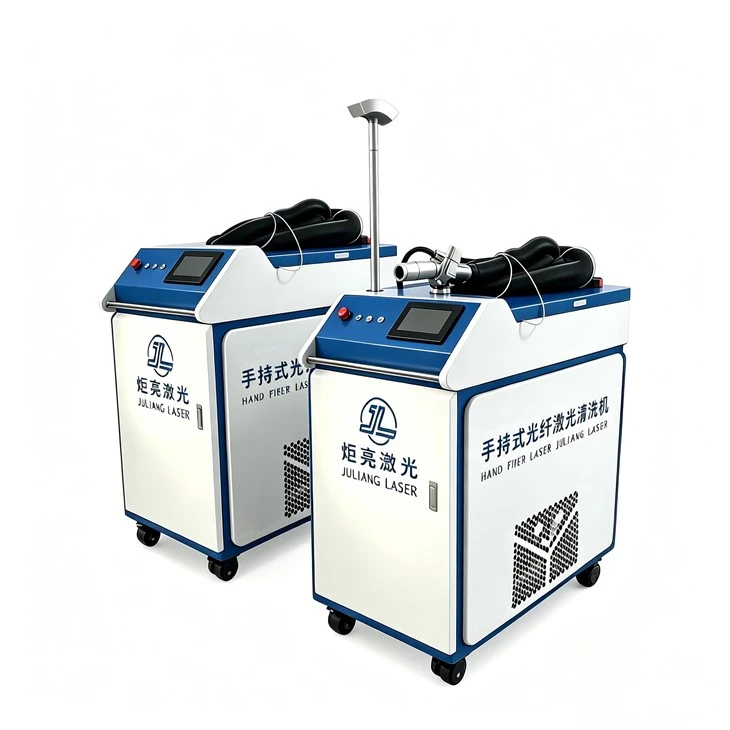
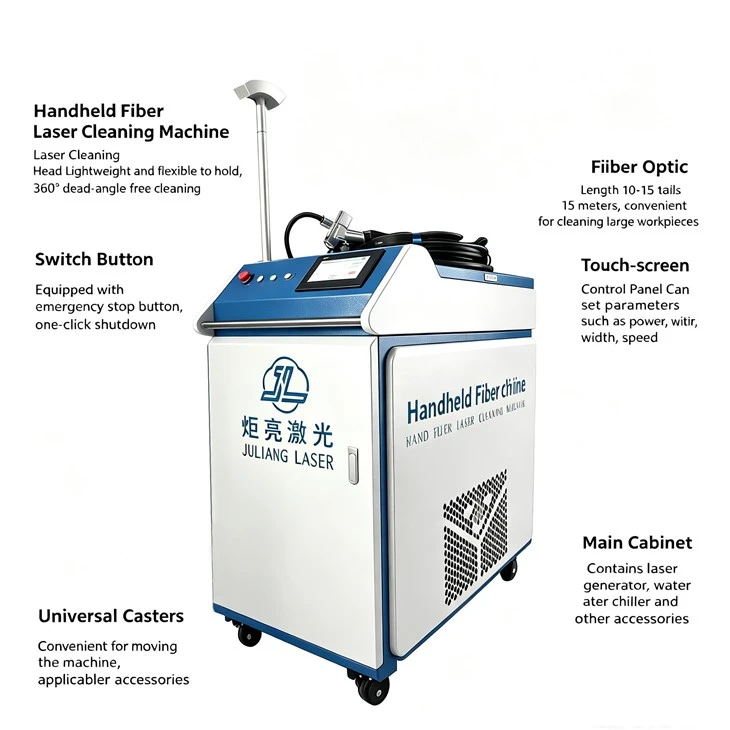
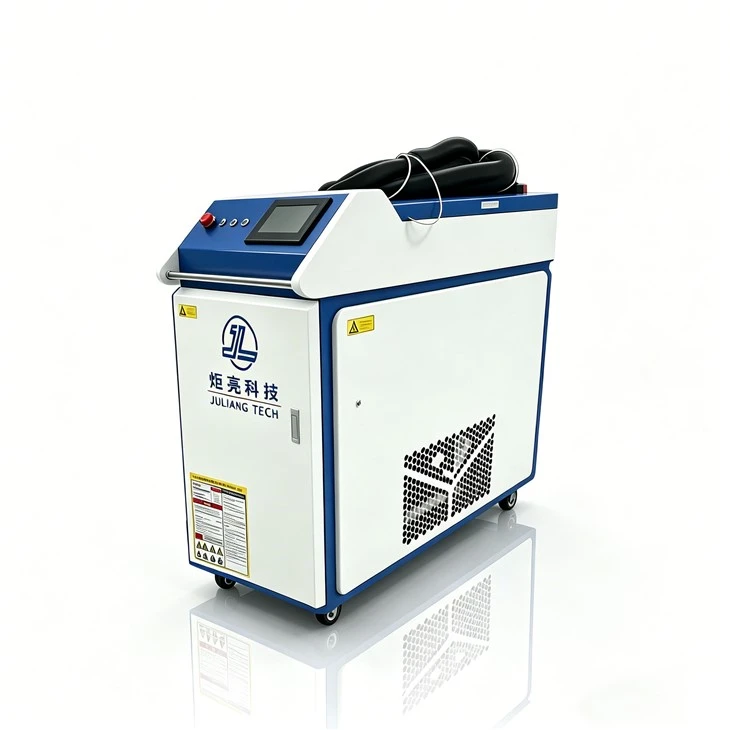
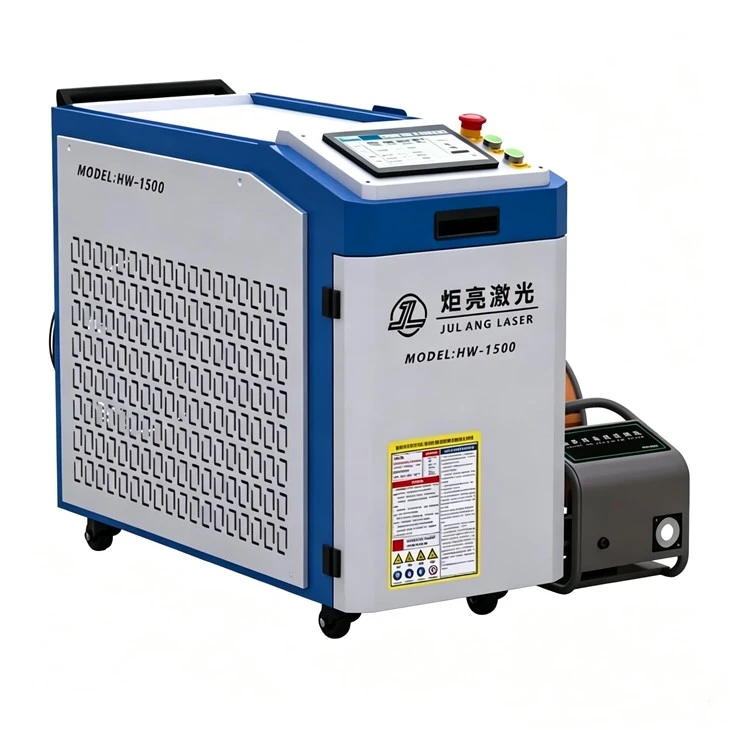
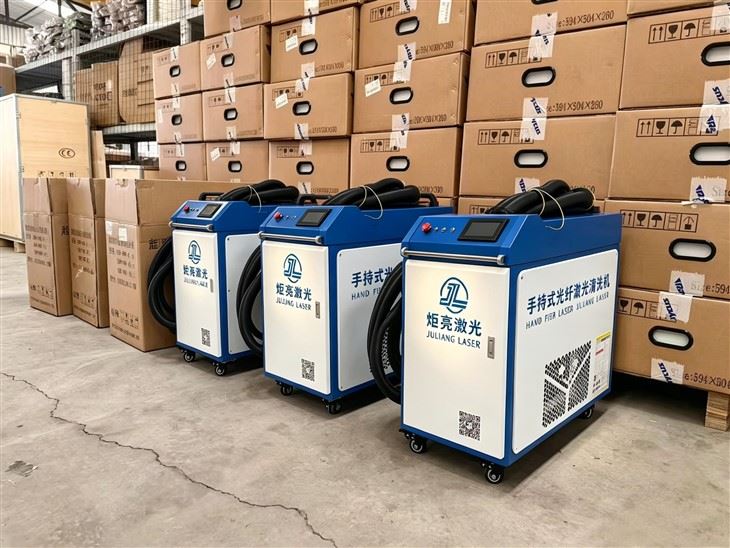
Hebei Juliang Technology Co., Ltd. is one of the leading manufacturers and suppliers of air‑cooled handheld fiber laser cleaner for industrial rust & paint stripping in China. Please feel free to buy CE approved machinery made in China here from our factory. All customized machines are with high quality and competitive price.
Walk through any heavy industrial facility-shipyards, bridge fabrication plants, or mining equipment workshops-and you'll see the same bottleneck: surface prep. Removing old paint and deep rust is manual, slow, and physically punishing. Grinding discs wear down every hour, and chemical strippers require hazardous waste disposal and protective gear that slows operators down.
We built this Air-Cooled Handheld Fiber Laser Cleaner for Industrial Rust & Paint Stripping to solve that bottleneck. Instead of physically scraping the surface, it uses a concentrated beam of light that interacts only with the dark paint or rust layer. That layer absorbs the energy and vaporizes instantly, leaving the underlying steel completely untouched. The "air-cooled" part means you don't need a separate water tower or chiller setup; the cooling system is integrated directly into the chassis, making it easier to move around a large factory floor.

What This Machine Actually Is

At its core, this unit is a specialized version of a Compact Air-Cooled Laser Welding Machine. The internal architecture is nearly identical-the same rugged fiber laser source, the same power delivery board, and the same thermal management system. The only real difference is the handheld gun head we attach. Instead of a focused lens for precise welding, we use a defocused lens that spreads the beam over a wider area. This ensures it removes the contamination without melting the substrate.
The small red box next to the main unit is not a water tank; it's an air-cooled heat exchanger that pulls heat away from the laser diode. The airflow is driven by a high-CFM fan, which means you can run the machine continuously for 6-8 hours on a hot summer day without hitting an overheat alarm. That's a critical detail for industrial environments where downtime isn't an option.
Our Material Selection Logic
When we design equipment for industrial use, we can't just pick components that look good in a photo. We pick them because they survive the abuse of a 12-hour shift.
The Main Chassis: We used 2mm-thick cold-rolled steel with a double-layer powder coating. Why not aluminum? While aluminum is lighter, it expands more under thermal stress. The laser source generates heat, and a lightweight aluminum frame can warp slightly over time, misaligning the optical path. The steel frame maintains its structural rigidity, keeping the internal optics perfectly aligned for consistent paint removal.
The Handheld Gun Housing: We moulded the gun from a polycarbonate reinforced with 30% glass fiber. It is non-conductive, which means it won't transfer heat from the reflected beam to your palm. More importantly, we tested this polymer shell by dropping it onto a concrete slab from 2 meters twice-no cracking, no damage to the internal lens mount. Industrial sites are rough, and the gun has to survive rough handling.
The 10-Meter Fiber Cable: This is the most abused part of any handheld unit. We used a multi-layer construction: an inner steel spring coil, a thick protective nylon braid, and an abrasion-resistant outer jacket. During our factory validation, we dragged this cable across sharp steel plate edges for 500 cycles while pulling a 40kg weight. The optical signal integrity remained perfect. This prevents the sudden "power drop" that happens when a cheap cable gets kinked.
Installation and Commissioning
We keep the setup simple for industrial environments:
Position: Move the main unit and the red chiller to the work area using the heavy-duty casters.
Connect the Hoses: Attach the two color-coded quick-connect hoses from the chiller to the main unit.
Fill the Reservoir: Fill the chiller tank with distilled water and a standard automotive-grade antifreeze.
Power Up: Connect to a standard 220V, 16A grounded outlet.
Remote Calibration: We schedule a 40-minute remote video session. Our application engineer guides you through adjusting the focus ring on the gun until the beam spot is the perfect width for your specific paint thickness.
Factory Quality Control Process
Our QC standards are based on industrial reliability.
24-Hour Burn-In: Every unit runs at 80% of its maximum power for a full day. We monitor the internal temperature of the laser diode. If the diode temperature exceeds 45°C, the unit is rejected and we replace the heat sink.
Beam Profile Analysis: We use a CCD camera to photograph the beam. The spot must be a perfect circle. If it is oval, the cleaning will be uneven, leaving streaks of paint residue. We align the optics until the beam is perfectly round.
Ground Resistance Test: We measure the ground resistance to ensure there is no static build-up that could damage the electronic control board.
1. What is the difference between air-cooled and water-cooled for industrial paint stripping?
Air-cooled machines have a fan and radiator inside the chassis. They are more portable and easier to maintain. Water-cooled units require external tanks and have a larger footprint. For most standard 8-hour industrial shifts, our air-cooled system is sufficient, provided the ambient shop temperature is below 40°C.
2. Can this machine remove multi-layer paint systems (primer + topcoat)?
Yes, but you need to increase the power and slow down the scan rate. Each layer absorbs the energy differently. A primary pass might remove the topcoat, and a second pass will remove the primer. It works quickly, but you cannot expect to vaporize 0.3mm of paint in a single sweep.
3. Does the beam damage the metal underneath the paint?
It will not if the focus is set correctly. Our manual instructs you to calibrate the focal point using a scrap metal piece before touching the workpiece. The laser's energy is tuned for the dark pigments in the paint. The bright, reflective metal underneath reflects the beam and remains cool.
4. What safety equipment is required for an industrial shop?
You must provide laser safety goggles with an OD5+ rating (we supply one pair). We also require a fume extraction unit. The paint vapor, while not chemically toxic like solvent fumes, creates a dense cloud of fine dust that you shouldn't breathe in.
5. How do I select between the 1500W and 2000W models for paint removal?
The 2000W model will strip thick industrial paints about 25-30% faster. If you have a high-volume production line where prep time is the critical path, opt for the 2000W. For small job shops or occasional maintenance work, the 1500W is more cost-effective.


Hot Tags: air‑cooled handheld fiber laser cleaner for industrial rust & paint stripping, China air‑cooled handheld fiber laser cleaner for industrial rust & paint stripping manufacturers, factory, 2000 watt handheld cleaning laser, 2000w laser cleaner, Air Cooled Handheld Laser Rust Cleaner, High Power Handheld Laser Rust Cleaner, Industrial Handheld Laser Rust Cleaner, Portable Handheld Laser Rust Cleaner


