


Plasma Cutting Machine
What is Plasma Cutting Machine?
A plasma cutter, also known as a plasma cutting machine, uses a plasma stream to transfer energy to a conductive workpiece. The plasma stream is formed by forcing a gas—such as nitrogen, oxygen, argon, or even air—through a narrow nozzle. An electric current from an external power supply ionizes the gas, turning it into a plasma arc. This is why the process is often called plasma arc cutting. The plasma arc cuts the workpiece by first melting it, then blowing away the molten metal. Plasma cutting is widely used for cutting steel, stainless steel, aluminum, and other conductive metals.
-
![Huayuan Portable Plasma Cutting Machine]() Huayuan Portable Plasma Cutting MachineWhat This Machine Actually Is The Huayuan Portable Plasma Cutting Machine offers a lightweight, computer-driven cutting system that brings industrial-level plasma cutting to smaller workshops and...read more
Huayuan Portable Plasma Cutting MachineWhat This Machine Actually Is The Huayuan Portable Plasma Cutting Machine offers a lightweight, computer-driven cutting system that brings industrial-level plasma cutting to smaller workshops and...read more -
![Huayuan Plasma Cutting Unit]() Huayuan Plasma Cutting UnitProduct Overview A Huayuan Plasma Cutting Unit is a high-performance, inverter-based plasma power source designed for industrial metal cutting applications. It provides the electrical arc and...read more
Huayuan Plasma Cutting UnitProduct Overview A Huayuan Plasma Cutting Unit is a high-performance, inverter-based plasma power source designed for industrial metal cutting applications. It provides the electrical arc and...read more -
![Huayuan Plasma Cutter Machine]() Huayuan Plasma Cutter MachineHere's the deal with a Huayuan Plasma Cutter Machine it's an inverter power source that takes regular AC power and turns it into a high-frequency DC arc. This arc is what provides the...read more
Huayuan Plasma Cutter MachineHere's the deal with a Huayuan Plasma Cutter Machine it's an inverter power source that takes regular AC power and turns it into a high-frequency DC arc. This arc is what provides the...read more -
![Mison CNC Plasma Cutter]() Mison CNC Plasma CutterWhat This Machine Does A Mison CNC Plasma Cutter is a computer-controlled cutting system that uses an electrically conductive gas-heated to roughly 20,000°C-to slice through metal. The arc...read more
Mison CNC Plasma CutterWhat This Machine Does A Mison CNC Plasma Cutter is a computer-controlled cutting system that uses an electrically conductive gas-heated to roughly 20,000°C-to slice through metal. The arc...read more -
![Mison Metal Plasma Cutter]() Mison Metal Plasma CutterWhat This Machine Is A Mison Metal Plasma Cutter is a CNC-controlled system that uses an ionized gas arc-superheated to roughly 20,000°C-to slice through electrically conductive metals. The...read more
Mison Metal Plasma CutterWhat This Machine Is A Mison Metal Plasma Cutter is a CNC-controlled system that uses an ionized gas arc-superheated to roughly 20,000°C-to slice through electrically conductive metals. The...read more -
![Mison Industrial Plasma Cutter]() Mison Industrial Plasma CutterWhat This Machine Is A heavy-duty plasma cutting system that runs on compressed air and handles metal up to 25mm thick. The Mison Industrial Plasma Cutter uses an ionized gas arc-heated to roughly...read more
Mison Industrial Plasma CutterWhat This Machine Is A heavy-duty plasma cutting system that runs on compressed air and handles metal up to 25mm thick. The Mison Industrial Plasma Cutter uses an ionized gas arc-heated to roughly...read more -
![Huayuan Industrial Plasma Cutter]() Huayuan Industrial Plasma CutterWhat This Machine Is This Huayuan Industrial Plasma Cutter is a CNC thermal cutting system. It creates an ionized gas arc, superheated to approximately 20,000°C, to cut electrically conductive...read more
Huayuan Industrial Plasma CutterWhat This Machine Is This Huayuan Industrial Plasma Cutter is a CNC thermal cutting system. It creates an ionized gas arc, superheated to approximately 20,000°C, to cut electrically conductive...read more -
![Huayuan Metal Plasma Cutter]() Huayuan Metal Plasma CutterWhat This Machine Is? The Huayuan Metal Plasma Cutter is a computer-controlled thermal cutting machine. It employs an ionized gas arc, heated to approximately 20,000°C, to cut electrically...read more
Huayuan Metal Plasma CutterWhat This Machine Is? The Huayuan Metal Plasma Cutter is a computer-controlled thermal cutting machine. It employs an ionized gas arc, heated to approximately 20,000°C, to cut electrically...read more -
![Huayuan Gantry Plasma Cutter]() Huayuan Gantry Plasma CutterWhat This Machine Is A Huayuan Gantry Plasma Cutter is a CNC-controlled thermal cutting system that uses an ionized gas arc to slice through electrically conductive metals. The arc melts the...read more
Huayuan Gantry Plasma CutterWhat This Machine Is A Huayuan Gantry Plasma Cutter is a CNC-controlled thermal cutting system that uses an ionized gas arc to slice through electrically conductive metals. The arc melts the...read more -
![Huayuan Portable Plasma Cutter]() Huayuan Portable Plasma CutterWhat This Machine Is A Huayuan Portable Plasma Cutter is a mobile cutting system that uses an ionized gas arc to slice through steel, stainless steel, aluminum, and other conductive metals. The...read more
Huayuan Portable Plasma CutterWhat This Machine Is A Huayuan Portable Plasma Cutter is a mobile cutting system that uses an ionized gas arc to slice through steel, stainless steel, aluminum, and other conductive metals. The...read more -
![Economical Plasma Cutting Machine]() Economical Plasma Cutting MachineProduct Overview Looking for a budget-friendly thermal cutting option? This plasma cutter is a great choice for small fabrication shops, hobbyists, and light industrial jobs where cost is a...read more
Economical Plasma Cutting MachineProduct Overview Looking for a budget-friendly thermal cutting option? This plasma cutter is a great choice for small fabrication shops, hobbyists, and light industrial jobs where cost is a...read more -
![Huayuan CNC Plasma Cutter]() Huayuan CNC Plasma CutterWhat This Machine Is A Huayuan CNC plasma cutter is an inverter-based plasma cutting power source designed specifically for integration with CNC cutting tables and automated cutting systems. What...read more
Huayuan CNC Plasma CutterWhat This Machine Is A Huayuan CNC plasma cutter is an inverter-based plasma cutting power source designed specifically for integration with CNC cutting tables and automated cutting systems. What...read more


Key Advantages of Plasma Cutting
Cost‑Effective
Plasma cutting is comparatively cheap for medium‑thickness cuts. It is the most effective means of cutting medium‑thickness stainless steel and aluminum.
Excellent Cut Quality
It delivers high‑quality cutting for thicknesses up to 50 mm. The process results in minimal dross because it removes excess material during cutting, meaning very little finishing is required.
Wide Material Compatibility
Plasma cutting can be carried out on all conductive materials, including steel, stainless steel, aluminum, copper, and brass.
Smaller Kerf
Compared to flame cutting, plasma cutting has a significantly smaller cutting kerf, which reduces material waste.
Precision and Repeatability
CNC plasma cutting machines offer excellent precision and repeatability, making them ideal for complex shapes and high‑accuracy parts. The high level of accuracy also allows plasma cutting to handle more complex geometries.
Minimal Warping
The fast cutting speed significantly reduces heat transfer, so plasma cutting does not lead to warping.
Types of Plasma Cutting Machine
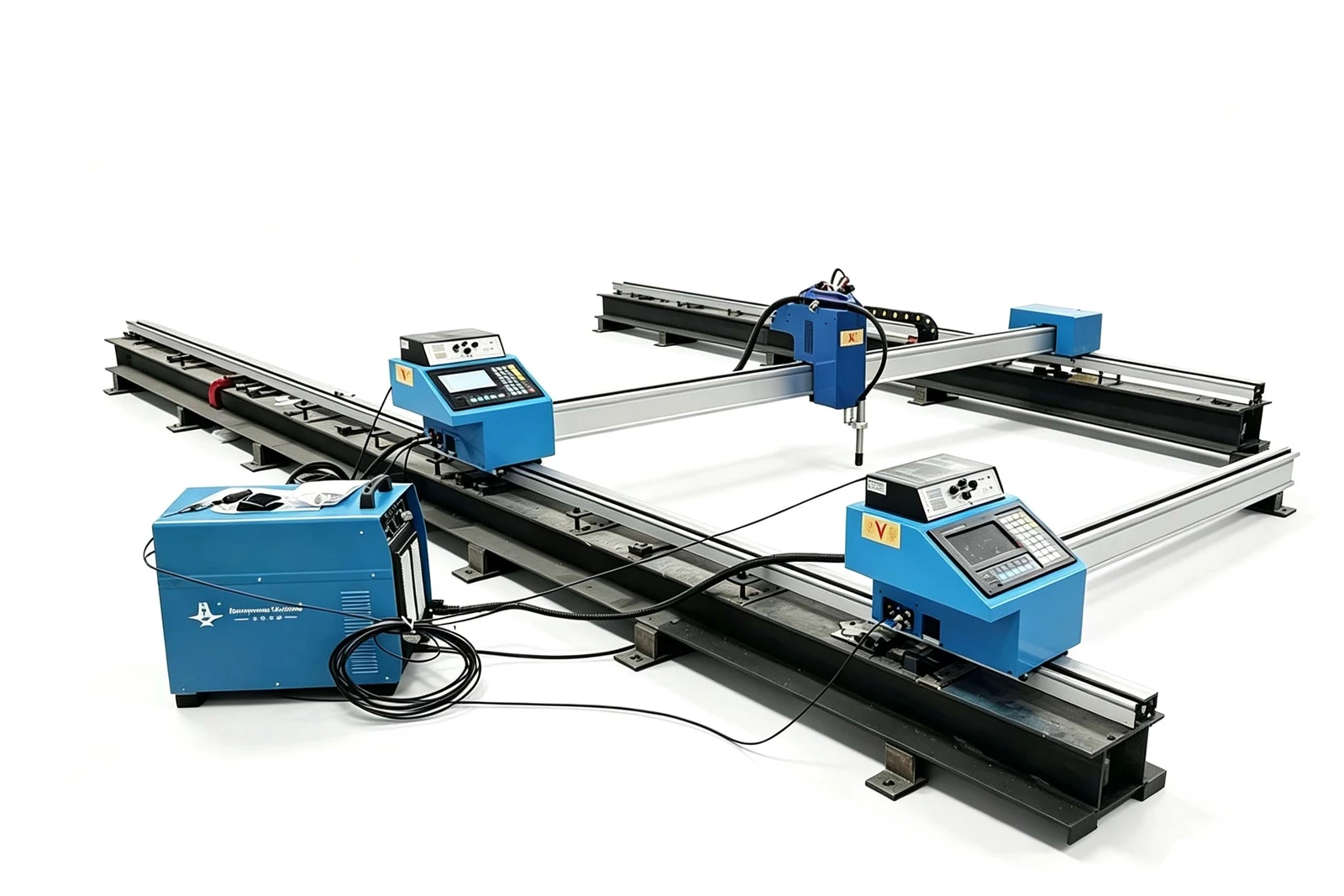
Plasma Cutting Machine for Misen
A plasma cutting machine configured for Misen power supplies and torches. It is compatible with Misen plasma sources and consumables, delivering stable arc performance for cutting steel, stainless steel, and aluminum. Suitable for both handheld and CNC‑controlled cutting, with power options to match different material thicknesses.
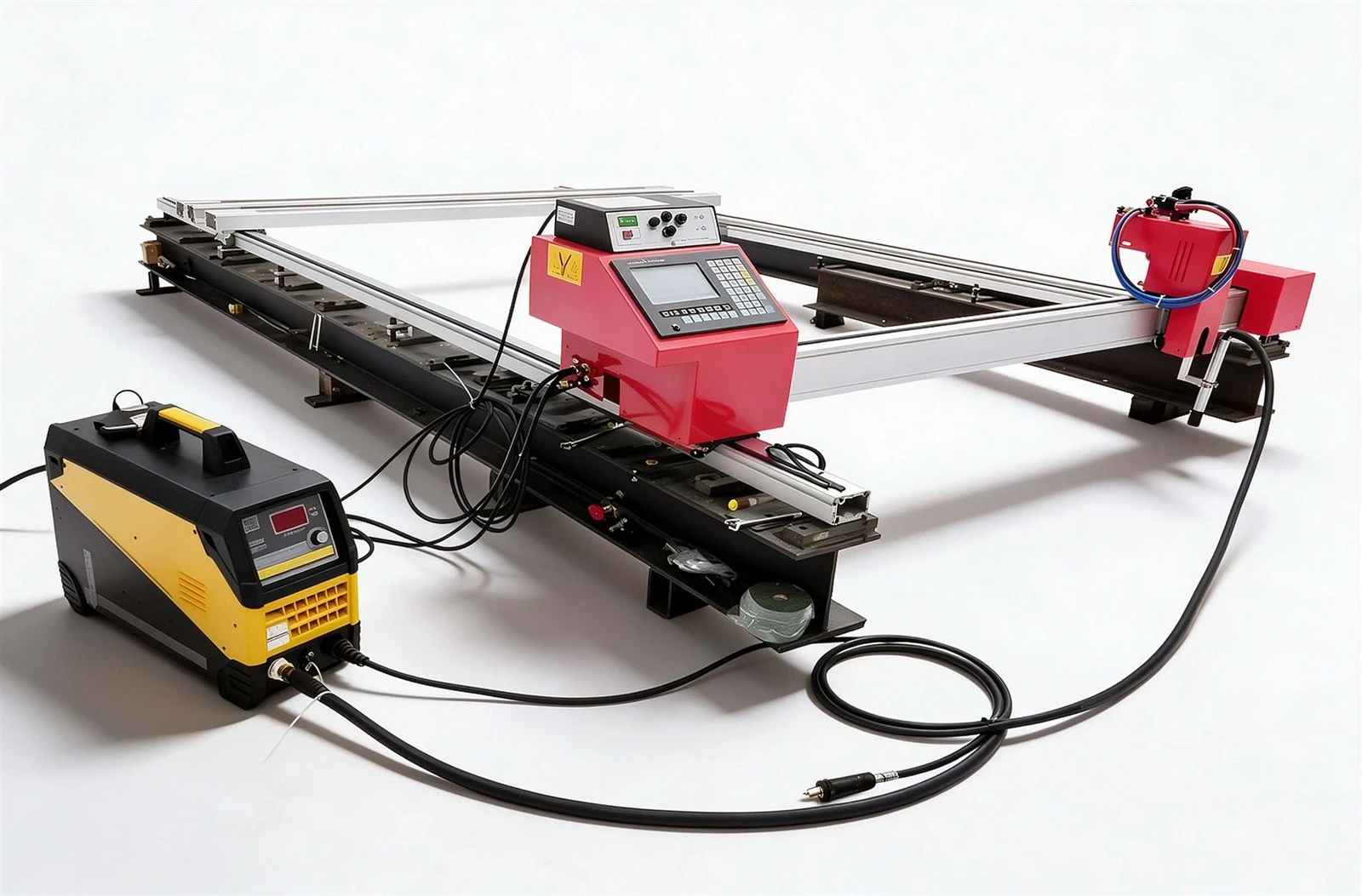
Plasma Cutting Machine for Huayuan
A plasma cutting machine configured for Huayuan power supplies and torch systems. It supports CNC cutting with programming and nesting software, and performs well on carbon steel, stainless steel, and aluminum. Available in a range of power options for different thickness requirements, making it suitable for steel structure fabrication, sheet metal processing, and general industrial cutting.
Applications of Plasma Cutting Machines
Plasma cutting machines are used across a wide range of industries, from large‑scale industrial production to small fabrication shops. Here are the main application areas:
Automotive Industry
The automotive industry uses plasma cutting machines to fabricate vehicle parts such as chassis components, exhaust systems, and structural elements. These machines cut through thick and thin metal sheets with high accuracy, ensuring consistent quality and minimal material waste.
Metal Fabrication and Sheet Metal Works
Metal fabrication is one of the most common applications. Plasma cutters cut various metals efficiently, allowing fabricators to create custom structures, frames, and components with precision. High‑definition plasma cutters handle intricate designs and produce clean, smooth edges, reducing the need for secondary finishing.
Construction and Infrastructure
In construction, plasma cutting machines are essential for cutting steel beams, pipes, and structural components. Their ability to cut thick, durable metals with minimal distortion makes them valuable for bridge building, skyscrapers, and other infrastructure projects.
Heavy Machinery Manufacturing
Heavy machinery manufacturing requires robust and precise cutting solutions. Plasma cutting machines excel at cutting thick steel plates and heavy‑duty materials, making them crucial for agricultural equipment, mining machinery, and industrial tools.
Aerospace Industry
The aerospace sector demands high precision and accuracy. Plasma cutting provides clean, smooth cuts for components such as aircraft frames and structural parts. Their ability to handle both lightweight and heavy metals makes them suitable for this demanding industry.
Salvage and Scrapping Operations
Plasma cutters are also used in salvage and scrapping operations, where speed and portability are important. Their ability to cut through thick, rusted, or painted metal quickly makes them a practical choice for dismantling and recycling
Parts of a Plasma Cutting Machine
A plasma cutting machine consists of several key components that work together to generate and control the plasma arc. Here are the main parts:
1. Power Supply
The power supply delivers the electrical energy required to create and maintain the plasma arc. It converts AC power from the mains into a stable DC output suitable for cutting. Consistent voltage and current are essential for smooth, efficient cutting performance.
2. Control Console
The control console contains the operating controls and settings. It allows the operator to adjust parameters such as amperage, cutting speed, gas flow, and torch height. It also includes safety features and status indicators to monitor the cutting process.
3. Plasma Torch
The plasma torch directs the plasma jet onto the workpiece. It holds consumables such as electrodes, nozzles, and swirl rings, which wear over time and must be replaced periodically. Torch design and consumable condition directly affect cut quality and operating cost.
4. Gas Supply System
The gas supply system provides the plasma gas and, in some setups, a shielding gas. Common gases include argon, nitrogen, oxygen, and compressed air. The choice depends on the material and required cut quality—for example, argon for stainless steel, compressed air for mild steel. Gas flow rate and pressure must be carefully controlled for optimal results.
5. Cutting Table
The cutting table supports the workpiece during cutting. It must be level and stable to maintain consistent torch height. Some tables include water beds or downdraft systems to reduce fumes, heat, and noise.
6. CNC Controller (for automated models)
On CNC plasma cutting machines, the controller reads the G‑code program and moves the torch along the programmed path. It also adjusts cutting parameters in real time to maintain cut quality.
Craftsmanship of Plasma Cutting Machine
The craftsmanship of a plasma cutting machine refers to the manufacturing quality, assembly precision, and process control that go into building the equipment. It directly affects cutting accuracy, machine reliability, and service life. Here are the key aspects:
1. Frame and Structural Welding
The machine frame is typically made of high‑strength steel. Welding quality determines the rigidity and stability of the machine. A well‑welded frame reduces vibration during cutting, which helps maintain consistent torch height and cut quality.
2. Guide Rail and Drive Assembly
The guide rails and drive system must be installed with high precision. Poor alignment can cause uneven movement and inaccurate cuts. Skilled assembly ensures smooth motion and long‑term accuracy.
3. Torch and Consumable Fitting
The plasma torch and its consumables—electrodes, nozzles, and swirl rings—must be fitted correctly. Even small alignment errors can affect arc stability and cut quality. Proper fitting also extends consumable life.
4. Cable and Hose Routing
Power cables, gas hoses, and control wires must be routed neatly and securely. Good routing prevents wear, reduces interference, and makes maintenance easier.
5. Calibration and Testing
Before delivery, each machine should be calibrated and tested. This includes checking cutting accuracy, arc stability, gas flow, and safety functions. Testing ensures the machine performs as specified.
6. Surface Treatment and Finishing
The machine frame and panels are usually sandblasted, primed, and painted for corrosion resistance. Good surface treatment protects the machine in harsh workshop environments.
7. Quality Control Throughout Production
Craftsmanship also means consistent quality control at every stage—from incoming material inspection to final assembly and testing. This reduces defects and ensures reliable performance.
How to Maintain a Plasma Cutting Machine
To keep your plasma cutting machine running at peak efficiency, follow the manufacturer’s instructions and carry out regular maintenance. Here are the key steps:
1. Clean the Machine Regularly
Disconnect the power supply first to prevent accidents. Wipe external surfaces with a damp cloth. Remove debris from the cutting surface and use compressed air or a soft brush to clear dust and dirt from components. Pay particular attention to the torch leads, torch assembly, electrode and swirl ring, plus filters and the cooling system if fitted.
2. Check Rail Alignment and Bearings
Make sure the rail sections and bearings are properly aligned, with no gaps between gears and racks. Proper alignment improves efficiency and cut quality.
3. Lubricate Moving Parts
Lubricate all moving parts, such as rails and bearings. Avoid excess lubricant, which can attract dirt. Proper lubrication reduces friction and prevents wear.
4. Check the Power Supply and Grounding
Remove the cover and use compressed air or a vacuum cleaner to remove dirt that can damage internal components. Make sure the power supply and ignition console are correctly grounded. Check the fans and filters for wear or damage, and replace them if necessary.
5. Inspect Air Filters and Cooling System
Ensure air filters show no signs of oil, moisture, or particulates. If they are discolored or dirty, replace them. If a cooling system is fitted, check the coolant level and top up if needed. If the coolant is grey or black, the pump may be failing and should be replaced.
6. Replace Worn Components
Replace parts that have reached the end of their service life or appear worn or damaged. This ensures efficient operation and prevents unexpected downtime.
7. Tune the Drive Motor and Control
If there are issues with torch positioning, the drive motor and control may need tuning. This should only be attempted by someone with the required technical expertise, as it is a time‑consuming job and requires familiarity with the inner workings of the equipment.
Our Service
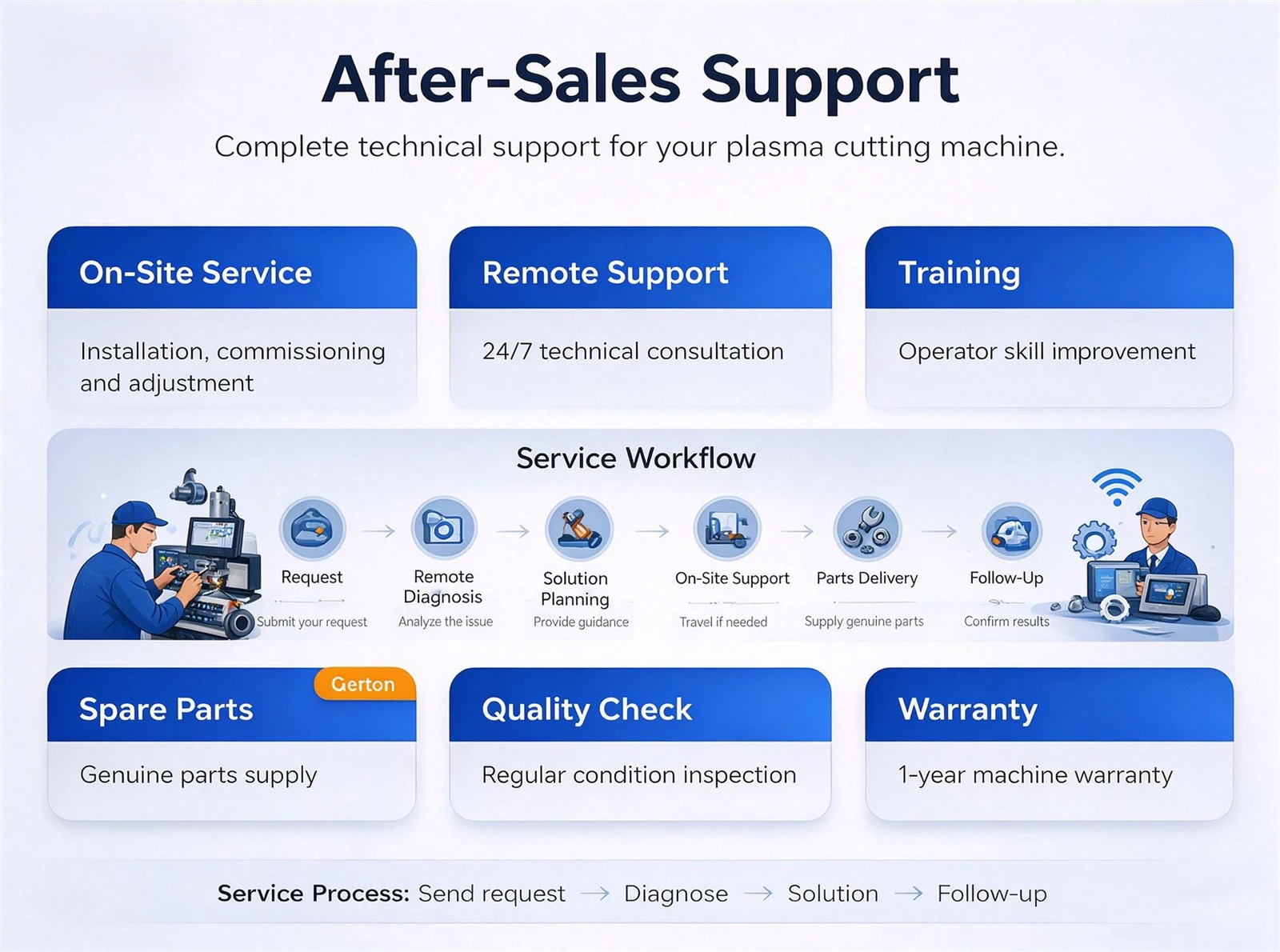
We provide full support before, during, and after your purchase to keep your plasma cutting machine running efficiently.
Pre‑Sales – Machine selection advice, customized solutions, and free sample cutting.
Sales – Order confirmation, production updates, quality inspection, and export packaging.
After‑Sales – On‑site installation and training, 24/7 remote technical support, genuine spare parts, and a 1‑year machine warranty.
Service Process – Send your request → remote diagnosis → solution (guidance, parts, or on‑site service) → follow‑up.
Our Certificate


why choose us

Hebei Juliang Technology Co., Ltd. is a high‑tech enterprise founded in 2014, specializing in fiber laser cutting machines, laser welding systems, and CNC cutting equipment. After three factory expansions, we now offer over 20 product specifications.
Our products are widely used in shipbuilding, steel structures, bridges, construction, mining machinery, and automotive manufacturing, and exported to Southeast Asia, Russia, Africa, Europe, and the Americas. We hold multiple patents, are CE certified, and recognized as a high‑tech enterprise.
Why Choose Us
Advanced equipment and strong R&D team
CE certified with multiple patents
Global export to 20+ countries
1‑year machine warranty, 2‑year laser generator warranty
24/7 support, free training
OEM/ODM available
Frequently Asked Questions
What maintenance is required?
+
-
Daily checks of consumables and gas; weekly cleaning of rails; regular inspection of filters, cooling system, and grounding.
What gases are used?
+
-
Common gases include compressed air, nitrogen, oxygen, and argon. The choice depends on the material and cut quality required.
How long do consumables last?
+
-
A: Electrode and nozzle life depends on current, material, and cut quality. Replace when cut quality drops or wear limits are reached.
Can a plasma cutter cut painted or rusty metal?
+
-
Yes. Plasma cutting can cut through painted, rusty, or dirty metal, making it useful for salvage and repair work.
How do I choose the right plasma cutting machine?
+
-
Consider material type, thickness, cutting volume, budget, and whether you need handheld or CNC operation. Contact us for a tailored recommendation.
What industries use plasma cutting machines?
+
-
Automotive, metal fabrication, construction, heavy machinery, aerospace, shipbuilding, and salvage and scrapping operations.
Can a plasma cutter cut painted or rusty metal?
+
-
Yes. Plasma cutting can cut through painted, rusty, or dirty metal, making it useful for salvage and repair work.
Does plasma cutting cause warping?
+
-
The fast cutting speed significantly reduces heat transfer, so warping is minimal compared to other thermal cutting methods.
Does plasma cutting produce dross?
+
-
Yes, but minimal. Proper parameters and good consumable condition reduce dross. High‑definition plasma systems produce very little dross, often requiring no secondary finishing.
What is a plasma cutting machine?
+
-
A plasma cutting machine uses a plasma arc to melt and cut conductive metals. It works by ionizing gas through an electric arc, creating a high‑temperature plasma jet that melts the metal and blows molten material away.
Hebei Juliang Technology Co., Ltd. is one of the most professional plasma cutting machine manufacturers and suppliers in China, featured by quality products and good service. Please rest assured to buy CE approved plasma cutting machine from our factory. Welcome to contact us for customized service and discount information.